Michael McMillan Presumed Innocent Unless Convicted, Prosecutors Say After Federal Indictment
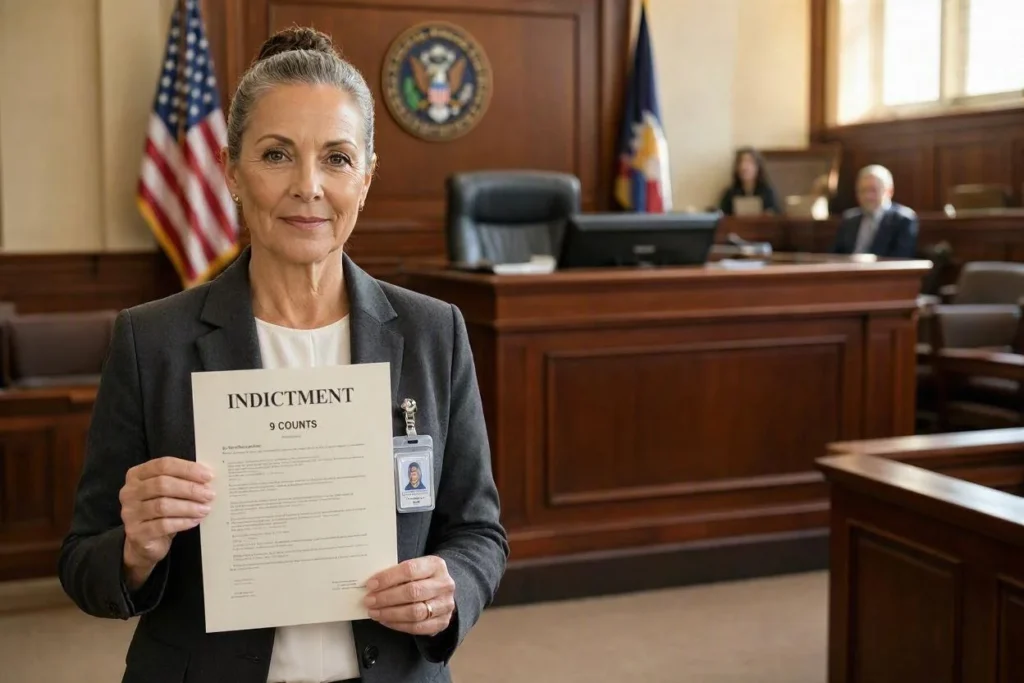
The federal indictment presents sweeping healthcare-fraud, kickback, and financial-transaction allegations involving Michael McMillan and Protectus-related businesses, but the Justice Department emphasizes that charging documents are accusations rather than evidence, and guilt requires proof beyond a reasonable doubt in court
WASHINGTON, DC — Michael McMillan remains presumed innocent after federal prosecutors charged the Las Vegas businessman in a nine-count indictment alleging healthcare fraud, illegal kickbacks, and monetary transactions connected with approximately $268 million in disputed government wound-care payments.
The indictment gives prosecutors a formal pathway to present their case, obtain discovery, litigate evidence, and seek a verdict, but it does not establish that McMillan committed any charged offense or that every allegation will survive adversarial examination.
The Justice Department expressly cautioned that an indictment constitutes an allegation of criminal conduct rather than evidence, while confirming that every defendant covered by the coordinated enforcement announcement remains innocent unless prosecutors prove guilt beyond a reasonable doubt.
That safeguard applies equally to sensational accusations involving large payment totals, luxury assets, healthcare programs, and vulnerable beneficiaries, because constitutional protections do not become weaker when a prosecution attracts national attention or generates emotionally powerful public reactions.
Responsible coverage must therefore describe what prosecutors allege, identify what the charging document actually contains, explain what remains disputed, and avoid converting a grand jury’s authorization to prosecute into the equivalent of a trial verdict.
The Justice Department’s Disclaimer Is Unambiguous
In its official Northern District of Texas enforcement announcement, the Justice Department states that an information or indictment represents only an allegation, not evidence, and that all defendants remain presumed innocent until proven guilty beyond a reasonable doubt.
That language is not a decorative footnote appended for institutional caution, because it summarizes a foundational allocation of responsibility: the government must prove every essential element, while McMillan can demand reliable, admissible, and legally sufficient evidence.
The caveat appears in the public announcement accompanying the charges rather than as a finding in the indictment, which matters because a charging document necessarily presents the prosecution’s theory without including a complete defense response.
Readers should consequently understand phrases such as “prosecutors allege,” “the indictment says,” and “the government contends” as meaningful descriptions of procedural status, not stylistic hedges that reporters may discard once accusations become widely repeated.
An Indictment Begins Litigation Rather Than Ending It
A federal indictment records charges approved through the grand-jury process, identifies alleged offenses, provides factual assertions supporting the government’s theory, and notifies the defendant about accusations that prosecutors intend to pursue in court.
The grand jury does not conduct a criminal trial, determine guilt beyond a reasonable doubt, hear the complete defense case, or decide whether punishment, restitution, and forfeiture should ultimately be imposed against the accused.
Grand-jury proceedings ordinarily occur without the defendant presenting the full adversarial response available at trial, making an indictment structurally different from a verdict reached after testimony, exhibits, objections, cross-examination, instructions, deliberation, and the defense’s presentation.
McMillan may challenge legal theories, factual assertions, search procedures, financial tracing, witness accounts, expert conclusions, claim interpretations, and evidentiary admissibility before any jury is asked to determine whether prosecutors carried their ultimate burden.
The Allegations Remain Serious Without Becoming Proven Facts
The indictment alleges that McMillan owned and controlled Protectus LLC and related Nevada entities that distributed skin-substitute wound-care products through arrangements prosecutors characterize as disguised rebates, discounts, and reimbursement-dependent provider kickbacks offered to participating clinicians.
Prosecutors contend that participating providers retained approximately thirty to forty percent of successful government reimbursements, while Protectus allegedly received approximately $174 million and medical providers allegedly retained approximately $94 million from challenged payments.
The charging document further alleges that sales representatives received about $27 million in compensation linked to reimbursements generated by recruited practices, while government programs allegedly paid about $268 million on disputed skin-substitute claims.
Each number may shape public perception, but every amount remains subject to proof of methodology, claim eligibility, payment history, legitimate value, repayment, contractual obligations, program rules, and the relationship between particular transactions and the charged conduct.
Nine Counts Require Individual Legal Findings
Count One alleges a conspiracy to commit healthcare fraud, Count Two alleges a separate conspiracy involving the United States and healthcare kickbacks, and Counts Three through Nine address seven monetary transactions involving property prosecutors characterize as criminally derived.
Charging nine counts does not produce nine findings of guilt, because every count requires proof of its own statutory elements and may turn upon different communications, participants, payment records, assets, dates, knowledge, and alleged objectives.
A jury could theoretically reach different conclusions across separate counts, while a court could dismiss or narrow particular allegations before trial if legal defects, evidentiary problems, jurisdictional questions, or procedural violations materially affect the government’s case.
The presumption of innocence attaches to McMillan across the entire indictment and does not diminish simply because prosecutors organized their allegations into multiple counts, described repeated conduct, or connected corporate receipts with conspicuous personal purchases.
The Government Bears the Burden Throughout the Case
McMillan does not need to prove that every Protectus transaction was lawful, establish an alternative explanation for every disputed record, or demonstrate personal innocence before requiring prosecutors to support the charges with admissible evidence.
The government must instead prove each essential element beyond a reasonable doubt, including any required agreement, intent, knowledge, material falsity, unlawful remuneration, inducement, criminally derived property, transaction value, and connection with federal jurisdiction.
That burden remains with prosecutors even when the defense introduces no evidence, because the accused may test the government’s witnesses, documents, calculations, and inferences while insisting that evidentiary gaps cannot be filled through speculation.
Jurors would ultimately receive instructions explaining the governing law, the presumption of innocence, the prosecution’s burden, the separate treatment of counts, and the requirement that any guilty verdict rest upon proof meeting the demanding criminal standard.
Beyond a Reasonable Doubt Exceeds Suspicion or Probability
An indictment may rest upon probable cause supporting prosecution, whereas conviction requires proof beyond a reasonable doubt, creating a deliberate difference between the threshold for formally accusing someone and the threshold for declaring that person criminally guilty.
The higher trial standard protects against conviction based merely upon suspicious business economics, public anger, unusual profits, complicated healthcare arrangements, expansive media coverage, or the understandable instinct to equate detailed government allegations with established truth.
Prosecutors may present evidence they believe demonstrates a coordinated payment system, but jurors must independently evaluate credibility, context, reliability, competing interpretations, and whether the complete evidentiary record excludes reasonable doubt concerning every required element.
If the evidence raises strong concern without meeting that standard, the required verdict remains not guilty, meaning prosecutors failed to meet their burden rather than proving every defense explanation affirmatively correct.
Contracts and Invoices Can Support Competing Interpretations
The government describes contracts, invoices, commission reports, emails, reimbursement records, and refund communications as components of an allegedly unlawful structure that rewarded providers and sales representatives when government healthcare programs paid skin-substitute claims.
McMillan’s defense may argue that some challenged arrangements represented lawful distribution terms, discounts, rebates, credit protection, consignment practices, sales compensation, billing support, or commercial risk allocation within a complicated and rapidly evolving reimbursement market.
The existence of ordinary-looking paperwork does not automatically establish lawful conduct, but neither does the prosecution’s criminal interpretation automatically resolve ambiguous language, accounting terminology, contracting purposes, regulatory notice, or participants’ states of mind.
Jurors may need expert assistance when evaluating whether acquisition-price disclosures, reimbursement-contingent invoices, provider retention, commission formulas, and claim procedures complied with applicable rules or instead carried the specific unlawful purpose alleged by federal prosecutors.
Witness Testimony Will Face Adversarial Testing
The indictment describes anonymized medical providers and sales representatives whose communications and transactions may become important evidence, but the charging document does not reveal each witness’s testimony, cooperation status, incentives, memory, or potential contradictions.
If such individuals testify, defense lawyers may examine financial interests, prior statements, plea discussions, immunity arrangements, document access, terminology, personal responsibility, and whether investigative interviews influenced how participants later characterized disputed business relationships.
Prosecutors may counter with contemporaneous emails, invoices, banking records, claim data, recurring calculations, and corroborating accounts intended to demonstrate that challenged arrangements operated consistently across numerous providers, sales representatives, affiliated companies, and extended periods.
The fact-finder must assess that evidentiary record after both sides have participated, rather than accepting an indictment’s summary as a substitute for direct testimony, authenticated exhibits, cross-examination, evidentiary rulings, and complete contextual presentation.
Government Claims About Healthcare Billing Must Be Proven
The prosecution alleges that claims submitted to Medicare and other government programs contained materially misleading acquisition-price information and were otherwise ineligible for federal reimbursement because providers allegedly selected products through prohibited financial inducements and kickbacks.
The defense can challenge who prepared each claim, who approved each field, what billing instructions were required, whether disclosed figures were materially inaccurate, and whether McMillan knowingly participated in any false representation capable of affecting payment.
Program-specific differences may also matter because Medicare, TRICARE, and CHAMPVA operate through distinct statutory, regulatory, contractual, and administrative structures, even though prosecutors place them within one broader narrative concerning federally funded wound-care reimbursement.
Evidence that one billing approach violated one program’s requirements would not necessarily resolve every disputed claim across every payer, provider, product, treatment, date, patient circumstance, and submission method identified during the alleged multi-year scheme.
Asset Seizure Is Not a Declaration of Guilt
Federal authorities announced approximately $35 million in seized assets connected with the case, while the indictment identifies residences, vehicles, an aircraft, and financial transactions that prosecutors contend may involve proceeds from the charged conspiracies.
Pretrial seizure generally preserves property while courts examine probable cause, tracing, ownership, statutory coverage, and competing interests, whereas permanent criminal forfeiture normally requires additional legal findings and may depend upon convictions or other authorized resolutions.
Expensive property can make accusations appear intuitively convincing, but luxury ownership does not prove an unlawful source, required knowledge, conspiratorial agreement, false claim, prohibited inducement, or the elements governing each charged monetary transaction.
McMillan and third-party claimants may dispute valuation, financing, liens, legitimate funds, account balances, commingling, ownership percentages, tracing methodologies, and statutory connections, but those property disputes do not independently establish innocence or guilt on the substantive charges.
Regional Enforcement Context Cannot Replace Individual Proof
An NBC 5 Dallas-Fort Worth report about the coordinated North Texas action described McMillan’s case alongside unrelated prosecutions, highlighting the alleged wound-care payments, luxury acquisitions, and broader enforcement focus involving elderly and military-connected beneficiaries.
The regional announcement covered thirteen defendants across seven cases involving more than $365 million in collectively alleged fraudulent billing, while the national takedown included hundreds of defendants and billions of dollars in disputed claims.
Those aggregate figures demonstrate the scale of enforcement activity, but allegations against laboratories, hospices, testing companies, equipment suppliers, clinicians, or other defendants cannot establish McMillan’s knowledge, intent, conduct, or responsibility within the Protectus prosecution.
Any eventual jury must consider admissible evidence tied specifically to McMillan and each charged count, without allowing campaign-wide statistics, unrelated patient stories, or generalized concern about healthcare fraud to substitute for individualized proof.
Public Language Can Influence Fairness Before Trial
Headlines often compress complicated accusations into brief declarations, creating a risk that search results will describe McMillan as responsible for a $268 million fraud even though the government itself identifies that figure only in unresolved allegations.
Accurate reporting should use attribution near significant claims, distinguish billed amounts from paid amounts, separate seized property from forfeited property, and avoid verbs suggesting that disputed transactions have already been adjudicated as criminal conduct.
The word “alleged” cannot repair every misleading sentence if surrounding language presents prosecutors’ interpretations as certainty, omits plausible procedural uncertainty, or implies that arrest, indictment, restraint, or arraignment constitutes a judicial finding of wrongdoing.
Conversely, emphasizing the presumption of innocence should not erase or minimize the charges, because responsible journalism can clearly explain serious government allegations while preserving the equally serious constitutional distinction between accusation and conviction.
Corporate Affiliates and Uncharged Participants Need Precision
The indictment identifies six related Nevada entities under the collective Protectus label, yet McMillan is the individual defendant named in the case caption, so careful attribution is essential when describing what particular companies, employees, or representatives allegedly did.
Common ownership may support the government’s theory of centralized control, but it does not automatically establish that every affiliated business, employee, vendor, medical provider, creditor, lender, or investor knowingly joined a criminal agreement.
Entity-specific contracts, accounts, invoices, payroll records, access logs, shipment histories, and communications may reveal materially different operational roles, while collective corporate language can obscure who possessed relevant knowledge or authorized a challenged transaction.
The presumption protecting McMillan also reinforces a broader reporting obligation not to portray uncharged individuals and organizations as convicted criminal participants merely because their names, payments, communications, or property appear within prosecution documents.
Pretrial Rulings May Reshape the Public Narrative
Before any trial begins, lawyers may litigate discovery production, search authority, electronic evidence, expert testimony, claim sampling, financial tracing, witness disclosures, venue, admissibility, forfeiture restraints, and the legal sufficiency of particular prosecution theories.
A judicial ruling excluding evidence can weaken a count, while admission of disputed records can strengthen the government’s presentation, meaning the evidentiary case ultimately heard by jurors may differ substantially from the indictment’s broad narrative.
Pretrial scheduling decisions, continuances, protective orders, and discovery disputes should not be interpreted as proof that either side lacks confidence, because complex healthcare prosecutions often require extensive review of technical records and numerous transactions.
Similarly, a court’s decision to allow a charge to proceed ordinarily means litigation may continue under the applicable standard, not that the judge has determined McMillan committed the charged conduct beyond a reasonable doubt.
A Plea Would Require an Informed Admission
The case could conclude through a negotiated guilty plea, a trial, dismissal, or another lawful resolution, but no particular outcome can responsibly be predicted solely from the indictment’s detail, financial magnitude, or public enforcement context.
Any guilty plea would require McMillan to act knowingly and voluntarily while providing an adequate factual basis accepted by the court, transforming unresolved accusations into admitted conduct only to the extent established through that formal proceeding.
If McMillan maintains a not-guilty plea and proceeds to trial, prosecutors must present admissible evidence for jurors, while defense counsel may challenge witnesses, offer exhibits, call experts, propose alternative interpretations, and argue reasonable doubt.
An acquittal would mean the government failed to prove one or more necessary elements beyond a reasonable doubt, while a dismissal could arise from legal, evidentiary, procedural, strategic, or jurisdictional considerations carrying different implications.
Sentencing Questions Remain Premature
Maximum statutory penalties describe legal ceilings associated with charged offenses rather than predictions, and sentencing analysis becomes relevant only if McMillan is convicted through a verdict or enters a guilty plea accepted by the federal court.
Any eventual sentence would depend upon sustained counts, proven loss, personal role, criminal history, obstruction findings, acceptance of responsibility, victim evidence, advisory guidelines, statutory factors, party arguments, and the sentencing judge’s reasoned discretion.
Restitution and forfeiture would involve separate legal questions concerning victims, legitimate value, traceable proceeds, recovered property, ownership interests, repayments, credits, offsets, and statutory authority, rather than following automatically from the indictment’s headline figures.
Publishing confident prison estimates before conviction can seriously mislead readers, prejudice public understanding, and collapse multiple contingent proceedings into a premature punishment narrative that the present charging document cannot legally or factually establish.
Reputation Damage Can Precede Courtroom Resolution
An indictment linking a named businessman with Medicare, military healthcare programs, alleged kickbacks, approximately $268 million in payments, private aircraft, costly residences, and luxury vehicles can dominate online identity long before a jury evaluates evidence.
People and organizations confronting that imbalance may require disciplined crisis public-relations management that coordinates with counsel, corrects verifiable inaccuracies, protects confidential information, and consistently distinguishes allegations, procedural developments, and adjudicated facts without interfering with legitimate investigation.
Longer-term reputation-rebuilding strategies can document verified compliance improvements, independent audits, leadership decisions, court rulings, and final outcomes without concealing material history or inaccurately presenting an unresolved prosecution as either proven guilt or complete exoneration.
Communications should remain measured because categorical public denials, attacks on witnesses, premature factual explanations, and speculative legal claims can conflict with later filings, undermine counsel’s strategy, expose confidential information, or unfairly implicate uncharged participants.
Compliance Lessons Do Not Depend Upon Declaring Guilt
Healthcare distributors can study the allegations without assuming McMillan’s guilt by carefully examining reimbursement-dependent invoices, provider-retained percentages, representative commissions, acquisition-price disclosures, billing assistance, refund practices, and corporate approval systems for potential regulatory risk.
Medical practices should independently evaluate arrangements offering no upfront payment, no liability after claim denial, and predictable profit after reimbursement, particularly when the supplier also provides billing guidance or compensates recruiters from collected program payments.
Companies should preserve complete contracts, amendments, invoices, claim instructions, commission reports, bank records, training materials, legal advice, and approval histories because contemporaneous documentation may eventually demonstrate either prohibited intent or legitimate commercial reasoning.
Drawing preventive lessons from an indictment differs fundamentally from announcing that its allegations are true, because risk management asks what controls could avoid ambiguity while criminal adjudication asks whether one defendant violated particular statutes beyond a reasonable doubt.
What Happens Next in the Michael McMillan Case
The prosecution may attempt to prove that Protectus arrangements deliberately rewarded product selection, obscured providers’ true acquisition costs, generated ineligible government claims, compensated recruiters through reimbursement-linked commissions, and converted resulting proceeds into substantial property transactions.
The defense may seek lawful explanations for product pricing, credit risk, rebates, provider independence, sales work, billing practices, refunds, affiliated-company operations, and individual asset purchases while contesting the government’s interpretation of intent and knowledge.
Discovery, motions, witness decisions, expert analysis, plea discussions, evidentiary rulings, trial strategy, and financial tracing may materially change which allegations remain central, which facts become undisputed, and which contested questions reach a jury.
Until a valid guilty plea, trial conviction, or other legally sufficient adjudication establishes criminal responsibility, Michael McMillan remains presumed innocent, and prosecutors must prove every charged offense beyond a reasonable doubt in federal court.
The distinction is neither technical nor optional, because an indictment authorizes prosecution while the presumption of innocence protects the integrity of the process that must determine whether the government’s detailed accusations can actually become proven facts.