Terminal Authentication Affects Access to Passport Fingerprint Data
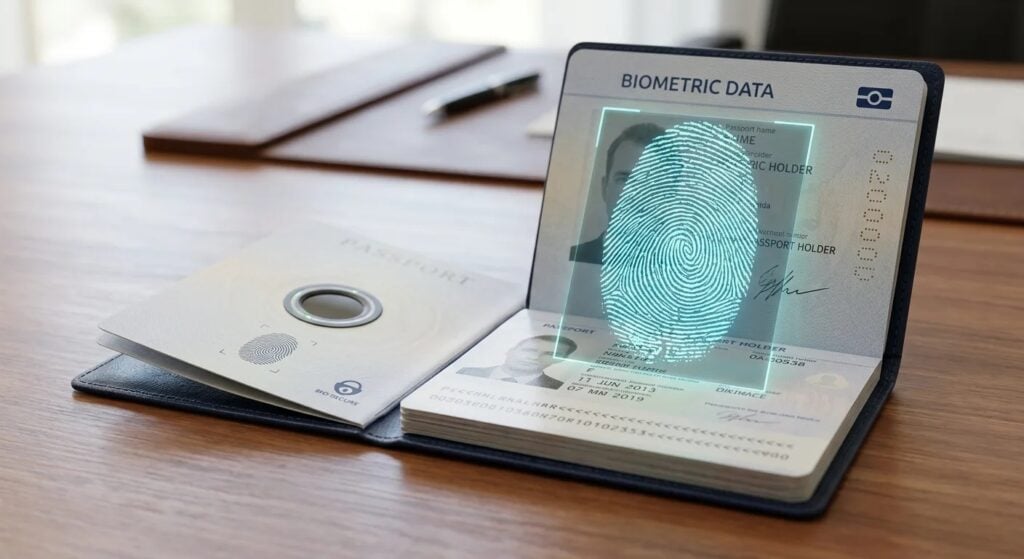
Inspection equipment must demonstrate its authorization through verified credentials before the chip releases restricted information.
WASHINGTON, DC, October 13, 2026 — Electronic passports that store fingerprint information can impose additional cryptographic requirements before releasing those sensitive records, ensuring that technical compatibility with the contactless chip does not automatically grant every passport reader permission to retrieve protected biometric data.
Terminal Authentication provides additional control by requiring inspection equipment to prove it holds recognized authorization credentials, allowing the passport chip to determine whether the requesting terminal has sufficient rights before granting access to protected fingerprint information.
Terminal Authentication Reverses the Usual Trust Question
Most electronic passport procedures focus on whether an inspection system can trust the document, but Terminal Authentication introduces an equally important question: whether the passport should trust the equipment requesting access to particularly sensitive stored information.
Under the ICAO electronic passport security framework, successful Terminal Authentication allows the chip to grant access to sensitive stored data according to the effective authorization associated with the authenticated inspection terminal.
Fingerprint Information Can Receive Special Protection
Within standardized electronic passport structures, fingerprint records can be stored in Data Group 3, while additional biometric categories can have their own defined locations and access conditions, depending on the document implementation.
ICAO’s current specifications explicitly identify a Terminal Authentication access right for reading Data Group 3 fingerprint information, demonstrating that fingerprint retrieval can depend upon separately verified authorization rather than ordinary electronic passport access alone.
Ordinary NFC Capability Is Not Enough
A reader may possess compatible radio-frequency hardware, understand international passport protocols, and successfully communicate with the electronic document while remaining unauthorized to retrieve fingerprints protected behind stronger access controls.
This separation prevents technical capability from equaling institutional authority, because the passport expects cryptographic evidence of recognized permission before releasing information whose sensitivity justifies stricter controls.
PACE Can Establish the Initial Protected Connection
Password Authenticated Connection Establishment (PACE) can establish secure communication between the passport and inspection equipment and derive strong session keys that protect subsequent electronic exchanges from unauthorized observation and manipulation.
Completing PACE does not automatically grant access to fingerprint information because secure communication establishes a protected channel, while Terminal Authentication separately determines whether the reader is authorized to access data protected by higher access restrictions.
Chip Authentication Strengthens the Electronic Relationship
In European Extended Access Control architectures, Chip Authentication can provide evidence of the electronic passport chip’s authenticity while establishing cryptographically protected session information for later communication with the inspection terminal.
ICAO describes the European Extended Access Control sequence as involving chip access, Chip Authentication with Passive Authentication, and then Terminal Authentication before the system obtains access according to the authorization established for the terminal.
Terminal Authentication Tests the Reader’s Credentials
After the passport and reader establish the necessary electronic relationship, Terminal Authentication requires the inspection system to present certificates and perform a cryptographic operation that demonstrates it holds the corresponding authorized private credential.
The passport evaluates that evidence rather than simply trusting a claim that the device belongs to a border authority, giving the document a mathematical basis for deciding whether the terminal deserves access to restricted biometric information.
A Certificate Chain Establishes the Reader’s Authority
Terminal credentials form part of a trust structure that lets the passport determine whether an inspection terminal ultimately connects to an authority recognized to grant access to protected biometric records.
The chip does not merely examine the terminal’s final certificate in isolation, because effective authorization depends upon the validated certificate chain and the rights represented across the credentials supporting the inspection system.
Authorization Rights Are Embedded in the Credentials
ICAO specifications use Certificate Holder Authorization Templates to represent the role and access rights associated with certificate holders, providing a structured way to communicate whether a particular inspection system can read protected biometric data.
The current logical data structure specifications identify distinct authorization bits for Data Group 3 fingerprints and Data Group 4 iris information, keeping sensitive access permissions more precise than a single universal authorization covering every biometric category.
Effective Authorization Can Be Narrower Than One Certificate Suggests
Electronic passport systems can calculate effective authorization from several certificates within the validated trust path, meaning the terminal receives only the rights that remain permitted throughout the relevant credential hierarchy rather than automatically inheriting the broadest permission found anywhere.
ICAO describes this determination through authorization information carried by inspection-system, document-verifier, and certification-authority credentials, creating a layered model intended to prevent lower-level terminals from expanding their own privileges independently.
The Terminal Must Demonstrate Possession of Its Private Key
A valid-looking certificate provides incomplete protection if another device can copy it and claim the same authorization, so Terminal Authentication includes cryptographic proof of possession.
The inspection system must demonstrate access to the private credential corresponding to its verified public information, giving the passport evidence that the current terminal possesses the secret associated with the authorization rather than merely displaying copied certificate data.
The Passport Generates a Fresh Authentication Challenge
Terminal Authentication can involve a fresh challenge generated by the electronic document, requiring the inspection system to create an appropriate cryptographic response tied to the current interaction rather than replaying an old authentication message.
Fresh challenge material strengthens the process because a previously recorded response should not ordinarily satisfy another session containing different cryptographic input, forcing the terminal to demonstrate its authorized capability when the passport actually requests access.
Successful Authentication Does Not Automatically Mean Unlimited Access
When Terminal Authentication succeeds, ICAO specifies that the chip grants access to sensitive information based on the terminal’s effective authorization, meaning successful reader identity verification does not automatically expose every protected record in the document.
This distinction allows one authenticated inspection system to receive fingerprint access while another legitimate terminal remains restricted to other functions based on the privileges in its verified credentials.
Authentication and Authorization Remain Separate Concepts
Authentication establishes confidence in the identity or cryptographic legitimacy of the requesting terminal, while authorization determines what that authenticated terminal can do after its credentials are accepted.
Keeping these concepts separate prevents a legitimate government system from automatically gaining privileges beyond those required for its approved operational purpose simply because the passport verified the terminal’s cryptographic identity.
The Passport Enforces the Decision Internally
A key security property is that the contactless chip can enforce restrictions on protected data rather than relying on reader software to voluntarily avoid requesting information it should not receive.
When effective authorization lacks appropriate rights, the passport can refuse the sensitive-data request, creating a technical access boundary that remains meaningful even when unauthorized equipment understands the underlying electronic communication protocols.
Secure Messaging Remains Connected With the Authorized Session
ICAO specifies that terminal access rights remain tied to secure messaging established using authenticated ephemeral public-key information, linking privileged data retrieval to the cryptographically protected session in which the terminal demonstrated its authorization.
This connection reduces opportunities for one device to authenticate successfully and then transfer its privilege casually to another unrelated connection that did not participate in the same protected electronic relationship.
Terminal Authentication Does Not Replace Passive Authentication
A reader can possess legitimate authority to request fingerprint information while still needing confidence that the passport’s protected electronic records originated from the expected issuing authority and remain unchanged from legitimate personalization.
Passive Authentication addresses that separation by evaluating digitally signed passport information and cryptographic reference values, ensuring that authorization to obtain information does not substitute for verifying the integrity of the information obtained.
Chip Authentication and Terminal Authentication Protect Opposite Sides
Chip Authentication gives the reader additional evidence concerning the passport chip, while Terminal Authentication gives the passport additional evidence concerning the reader, creating a more reciprocal trust relationship than ordinary document reading provides.
That complementary structure is especially appropriate when sensitive biometrics are involved because both endpoints need stronger confidence before the document permits the most restricted information to move through the electronic session.
European Passport Rules Require Protection Against Unauthorized Access
The European Union passport-security framework requires biometric information stored in Member State passports to receive security protections that address integrity, authenticity, confidentiality, and unauthorized access prevention.
The same European framework states that national legislation, subject to applicable European Union law and international agreements, determines which authorities may access information stored in passport media.
Fingerprint Data Have a Restricted Legal Purpose
European Union rules specify that biometric features stored in passports and travel documents are used to verify document authenticity and confirm the holder’s identity when the travel document must lawfully be produced.
This legal purpose complements the technical architecture because cryptographic authorization can control which systems receive biometric information, while legislation defines the circumstances and purposes under which authorities may use that capability.
A Government Reader Still Needs the Correct Credentials
The fact that equipment belongs to a public authority does not automatically grant technical authorization, because the inspection terminal must have credentials whose trust path and encoded permissions meet the access conditions enforced by the passport.
This design creates a stronger boundary than relying exclusively upon organizational policy, since the chip can refuse access when the current terminal cannot demonstrate the cryptographic authorization required for the protected information it requests.
Foreign and Domestic Terminals Can Receive Different Roles
ICAO’s authorization structure distinguishes among certification authorities, document verifiers, and inspection systems while also accommodating distinctions between domestic and foreign document-verifier roles within the broader Extended Access Control credential hierarchy.
Such distinctions support controlled international biometric access because an issuing authority can participate in trust relationships without treating every foreign inspection environment as having precisely the same authority as its own domestic systems.
Cross-Border Fingerprint Access Can Depend on Trust Relationships
A passport may be globally interoperable for routine identity and facial-image verification while access to stored fingerprints remains limited through certificate arrangements established among governments that recognize one another’s authorization infrastructures.
This model allows international travel to function normally without requiring universal distribution of sensitive biometric access rights to every jurisdiction capable of reading ordinary electronic passport information.
Fingerprint Access and Fingerprint Matching Are Different Steps
After an authorized terminal retrieves a stored fingerprint record, the inspection system still needs an appropriate live biometric sample and comparison process before determining whether the traveler corresponds with the protected reference information.
Terminal Authentication therefore controls access to the reference biometric, while fingerprint verification addresses the separate evidentiary question of whether the person presenting the passport sufficiently matches that stored record.
The Facial Image Usually Follows a Different Access Model
The electronic facial image serves as the primary internationally interoperable biometric and can support routine one-to-one comparison at automated gates and staffed border checkpoints across many countries.
Fingerprints can receive stronger restrictions because ordinary international passport processing does not require every compatible reader to obtain secondary biometric records simply to establish the traveler’s relationship with the document.
A Consumer Smartphone Normally Lacks Terminal Credentials
A commercially available smartphone can possess NFC hardware, capture machine-readable information, establish PACE communication, and retrieve standard passport records without possessing the government-issued certificate chain required for privileged fingerprint access.
A successful consumer scan therefore does not prove the application obtained every biometric stored on the passport, because properly functioning Terminal Authentication can prevent unauthorized software from accessing protected fingerprint information.
Failure to Retrieve Fingerprints Can Indicate Proper Security
When an application reads standard passport information but can’t retrieve fingerprint records, the result may simply mean the chip is correctly enforcing additional access restrictions, not that it’s damaged, missing biometrics, or fraudulent.
Software limitations, missing stored fingerprints, unsupported protocols, and insufficient authorization can all produce similar visible outcomes, so careful interpretation is essential before drawing conclusions from a failed fingerprint-reading attempt.
The ICAO Public Key Directory Does Not Grant Fingerprint Rights
Public certificates used to validate passport signatures serve a different function than Terminal Authentication credentials, so access to international document-authentication information does not automatically grant permission to retrieve sensitive biometric data.
This separation prevents participation in international passport verification infrastructure from becoming equivalent to receiving privileged biometric access, preserving distinct trust mechanisms for document authenticity and terminal authorization.
Terminal Authentication Protects Data Before Disclosure
Many security discussions concentrate upon protecting biometric information after authorities obtain it, but Terminal Authentication adds an earlier control by determining whether the reader should receive the protected information in the first place.
Preventing unauthorized disclosure at the chip level reduces dependence upon downstream promises that an improperly accessed fingerprint will later be handled responsibly, because the protected data remain unavailable when the requesting terminal lacks sufficient rights.
Secure Messaging Protects the Biometric During Transfer
Once authorization succeeds, fingerprint information can travel through the secure electronic session established between the passport and inspection system, receiving confidentiality and integrity protections while crossing the contactless radio-frequency interface.
This combination creates several barriers around the same sensitive information, including restricted access before disclosure and cryptographic protection while the authorized biometric record moves between legitimate electronic endpoints.
Authorization Certificates Need Lifecycle Management
Terminal certificates and their supporting authorities cannot be issued once and trusted forever because government responsibilities, security conditions, organizational roles, and cryptographic technologies can change over the operational life of passport systems.
Credential infrastructures therefore require issuance, validity periods, controlled renewal, and mechanisms for managing changes in trust so obsolete or unauthorized inspection equipment does not retain privileged biometric access indefinitely.
The Passport Evaluates Current Credentials During the Session
Because the reader must demonstrate authorization when requesting protected access, the system can base the decision on credentials available during the current electronic interaction rather than relying solely on a permission permanently embedded when the passport was manufactured.
This capability gives authorization frameworks greater flexibility because governments can manage inspection credentials independently from the long validity periods commonly associated with physical passports carried by travelers.
Terminal Authentication Does Not Establish Current Passport Validity
An electronic document can authenticate an inspection terminal successfully even after the passport itself has been canceled, revoked, or recorded as lost, because terminal authorization concerns the reader rather than the passport’s current administrative status.
Government document-status systems therefore remain necessary even within sophisticated Extended Access Control environments, preventing strong biometric security from being confused with confirmation that the travel document remains legally valid.
Immigration Eligibility Also Remains Separate
A terminal authorized to retrieve fingerprints cannot, on that authorization alone, determine whether the traveler has a valid visa, meets residence requirements, or satisfies the receiving country’s broader legal conditions for admission.
Those determinations remain within immigration law and governmental border systems, reinforcing the principle that passport cryptography supplies specific evidence and permissions rather than making the entire border decision independently.
Physical Security Features Remain Necessary
Terminal Authentication cannot examine laser engraving, polycarbonate construction, optical devices, ultraviolet artwork, microprinting, watermarks, binding integrity, or other physical characteristics used to detect alteration of the passport booklet.
Strong electronic authorization therefore complements, rather than replaces, physical document examination, because sensitive biometric protection addresses a different security problem than determining whether someone manipulated the surrounding travel document.
The Model Demonstrates Bidirectional Trust
Traditional passport inspection asks whether the authority can trust the document, while Terminal Authentication demonstrates that advanced identity systems can also require the document to evaluate whether the requesting authority should receive particular information.
That bidirectional model becomes especially valuable for sensitive biometrics because the passport doesn’t need to disclose everything just because a reader can establish a technically successful connection.
Authorization Can Follow the Principle of Least Privilege
Granting only the biometric rights required for an inspection terminal’s approved role reduces unnecessary exposure because legitimate systems can perform ordinary functions without automatically receiving privileges irrelevant to their operational responsibilities.
A passport reader that requires only standard biographical data and facial verification can therefore remain functional without gaining the same access available to specialized inspection systems authorized for fingerprint comparison.
Sensitive Passport Biometrics Require More Than Compatibility
Through Amicus International Consulting’s passport security resource, readers can examine how Terminal Authentication complements PACE, Passive Authentication, Chip Authentication, secure messaging, physical document safeguards, and biometric holder verification within contemporary electronic passport security.
The defining principle is that understanding the protocol and having compatible hardware should not automatically grant access to biometric information whose sensitivity justifies stronger restrictions.
Terminal Authentication Places the Passport in Control of Disclosure
Terminal Authentication restricts fingerprint access by requiring inspection equipment to prove its authorization through verified certificates and cryptographic possession of the corresponding private credential before the chip grants privileges associated with protected biometric information.
The passport can evaluate the terminal’s effective access rights, maintain those permissions within the authenticated secure session, and refuse requests whose authorization does not include the fingerprint data being sought by the inspection system.
By letting the document itself enforce those restrictions, Terminal Authentication provides a key privacy and security safeguard that separates standard electronic passport compatibility from the higher level of trust required before sensitive biometric records become available.