The Lord Who Fled: Lord Lucan’s Half-Century on the Run
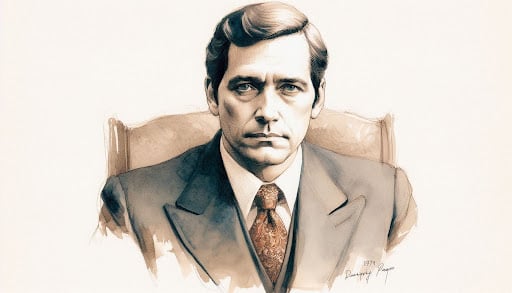
After a brutal 1974 crime, the 7th Earl of Lucan disappeared, fueling decades of sightings that only recently collided with modern facial-recognition claims and a stubbornly unsolved human mystery.
WASHINGTON, DC
Lord Lucan vanished so completely, and so theatrically, that Britain has never quite managed to decide whether his case belongs to criminal history, aristocratic folklore, or the darker national category reserved for men whose power seemed to help them outrun ordinary consequences.
That is why the story still grips people more than fifty years later: the basic outline is brutally simple, while the emotional afterlife remains sprawling and unresolved. A nanny was bludgeoned to death in a Belgravia basement. Lucan’s wife was badly beaten and escaped. Lucan drove away into the night and was never seen again in any provable sense. Everything that followed, the theories about wealthy friends, Africa, gambling circles, speedboats, monastic hideouts, and now facial-recognition claims on another continent, grew from the gap between one terrible night and the fact that the man at the center of it was never produced.
The official shape of the case has long been clear enough. Sandra Rivett, nanny to Lucan’s children, was murdered on Nov. 7, 1974. Lady Lucan survived a savage attack and identified her estranged husband as the assailant. An inquest jury in 1975 named him as Rivett’s killer. His abandoned, bloodstained car was found in Newhaven, East Sussex, but Lucan himself was gone. Decades later, a court granted a presumption of death certificate, yet even that legal step failed to kill the story, because the absence at its center had already become too culturally useful to surrender.
The 2016 death certificate ruling should, in theory, have closed the matter administratively. It allowed his son to inherit the title and gave the family formal legal finality. But law and folklore were never moving in the same direction here. A court can presume death after decades of silence. It cannot force the public to stop imagining that a rich, connected, aristocratic fugitive found a way to live under another sky.
The original crime was violent enough to destroy any chance of genteel ambiguity.
One reason Lucan’s story remains so singular is that the criminal event at its core was never light enough to be absorbed into harmless upper-class eccentricity. This was not a tax scandal, a financial disappearance, or a lover’s retreat into secrecy. Sandra Rivett died from repeated blows to the head. Lady Lucan escaped an assault and insisted her husband had attacked her. The inquest conclusion was devastating. Lucan was not merely a missing peer. He was, in the eyes of the official record, the man responsible for killing the children’s nanny.
That matters because the later mythology has often softened him into a vanished gentleman gambler who somehow slipped the net. The actual case is much uglier. The fascination with Lucan survives not because the crime was unclear, but because the disappearance that followed deprived the country of the trial, sentence, and visual accountability it would normally expect after such a killing.
That missing courtroom ending is what gave the legend room to grow.
If Lucan had been arrested in a marina in Spain in 1975, convicted, and sent to prison, he would now sit in history as another privileged British criminal whose class and charm failed to save him. Instead, he passed out of reach at exactly the point where the story should have narrowed and instead widened forever.
The public always believed someone helped him, because it was hard to imagine he could vanish alone.
This is where the Lucan mystery took on its distinctly British character. A petty criminal who vanishes after murder may inspire theories about new identities, ship work, or border crossings. An earl with money, clubland contacts, and powerful friends inspires something else. He inspires the suspicion that the old boys’ network did not merely fail to stop him, but actively helped him flee.
That suspicion never fully died because it matched the social world from which Lucan came. He moved among wealthy gamblers, titled men, fixers, and socialites who understood discretion as a form of currency. Stories swirled for decades that friends found him after the crime, moved him quickly, paid his bills abroad, or helped him disappear into southern Africa or beyond. Few of these accounts ever matured into evidence strong enough to force a legal conclusion, but they never needed to. Their function was explanatory. They gave the public a way to understand how a man so visible could become so unreachable.
The most persistent versions suggested he either killed himself very soon after fleeing or was quietly hidden by loyal and wealthy friends until some later death abroad. Both theories survive because each solves part of the problem. Suicide explains why no verified later life emerged. A managed escape explains why the early search seemed to fail so completely.
Neither theory has entirely defeated the other.
The sightings kept the mystery alive by making Lucan portable.
Few fugitives have been seen in as many places by as many convinced observers as Lord Lucan. The global scatter of these sightings is one reason the case aged so well as folklore. He was supposedly in Goa, South Africa, Australia, New Zealand, Paraguay, Hong Kong, the Bahamas, and enough other places to become less a man than a recurring imperial ghost.
The pattern tells us as much about the public as it does about Lucan. Once a fugitive becomes famous enough, every expatriate colony, every faded colonial outpost, and every strange Englishman abroad becomes a possible endpoint. Lucan was ideal for this treatment because he seemed built for the fantasy of privileged exile. He had class, accent, nerve, military bearing, gambling habits, and exactly the kind of face that could age into many plausible disguises.
Recent coverage by ABC News in 2024 captured the long and almost absurd history of reported sightings while restoring something important to the story: namely, that the obsession with Lucan often overwhelmed attention to Sandra Rivett and to Lady Lucan’s own ordeal. That correction matters. A half-century of manhunt mythology can easily turn the victim into background scenery and the fugitive into the star of his own disappearance. Lucan has too often benefited from that imbalance even in absentia.
Modern facial recognition did not solve the mystery, but it changed its tone.
The newer phase of the case began when old-fashioned sighting culture collided with claims of algorithmic certainty. In 2022, Professor Hassan Ugail of the University of Bradford said facial-recognition analysis suggested a remarkable match between historical images of Lucan and photographs of an elderly man living in Australia. The claim was dramatic enough to reignite the case internationally and powerful enough to make it seem, briefly, as though modern technology might finally do what decades of rumor never could.
The University of Bradford’s 2022 statement presented the comparison as a major analytical development and helped transform the old sighting story into something that sounded almost scientific. That shift mattered. For years, Lucan stories were sustained by tipsters, amateur sleuths, and journalists willing to chase aristocratic phantoms around the world. Facial recognition suggested the case might now move into a new evidentiary era.
But the promise quickly curdled. Reporting soon showed that the Australian man had already been investigated and eliminated by police. The Guardian’s 2022 account noted both the expert’s confidence and the Metropolitan Police’s statement that the man had, with assistance from Australian federal police, been conclusively ruled out.
That is what makes the facial-recognition phase so revealing. It did not solve the mystery. It showed how even the most modern tools can become part of the same old Lucan pattern, a fresh certainty, a burst of press attention, and then another collapse back into absence.
In some ways that strengthens the legend more than it weakens it. If even algorithmic matching cannot produce the body, the arrest, or the final verified identity, then the mystery survives not because nobody has looked, but because every method keeps finding only another possible mask.
Legal death did not end the hunt because the emotional case remained open.
When the High Court issued Lucan’s death certificate in 2016, it did so on the simple basis that he had not been known to be alive for decades. That is the proper function of the presumption-of-death law. It lets property, title, and family matters move on where proof of life has long since failed.
But the emotional logic of the Lucan case runs on a different track.
His son wanted the family to move on. Sandra Rivett’s son did not believe the story was fully over. Old investigators and journalists still circled the idea that some people knew more than they ever said. And the British public, which has always had a special appetite for aristocrats brought low, kept returning to Lucan because he represented a uniquely bitter possibility, that a man of rank may have escaped justice not through brilliance alone but through the cushioning effect of class.
That is one reason the case still resonates in broader writing about mobility, elite protection, and the way fugitives use status, networks, and distance to evade consequence, the same wider discussion that continues at Amicus International Consulting and in its analysis of cross-border extradition and long-tail fugitive cases. Lucan remains one of the clearest cultural examples of the public fear that privilege can do what passports alone cannot: stretch time, create shelter, and turn pursuit into folklore.
The deepest reason the mystery survives is that no one ever got the final image.
Every great fugitive story depends on an image it withholds.
For D.B. Cooper, it is the landing.
For Jimmy Hoffa, it is the burial place.
For Lucan, it is the afterlife of the crime.
Was there a moment, in Africa or Australia or some borrowed flat in Europe, when the 7th Earl of Lucan finally understood he would never come home? Did he die by his own hand within hours of the murder? Was he hidden by men who thought they were preserving a friend, only to embalm a national obsession? Or did he simply become one more unremarkable elderly Englishman in a faraway place, carrying a face that journalists and computers would chase long after the man inside it had changed beyond recognition.
That image never came.
What Britain got instead was a bloodstained nursery-world crime, a vanished aristocrat, a dead nanny, a wounded wife, a death certificate, and half a century of sightings that could not be pinned down even when modern software entered the chase.
That is why Lord Lucan remains such a potent figure in the British imagination. He is not only a fugitive. He is the embodiment of a suspicion that some men can disappear into the class system itself, aided by money, friends, and the public’s inability to stop picturing them alive somewhere beyond the reach of ordinary justice.
The case has grown old, but it has not gone quiet. Sandra Rivett is still dead. Lucan was still named as her killer by an inquest jury. The body of the fugitive was never found. And the newest technology, like the oldest rumor, has only managed to prove the same thing again: Lord Lucan is still absent, and absence remains the one disguise nobody has been able to strip from him.