Responding to Google Q&A Before Competitors Do in Cincinnati
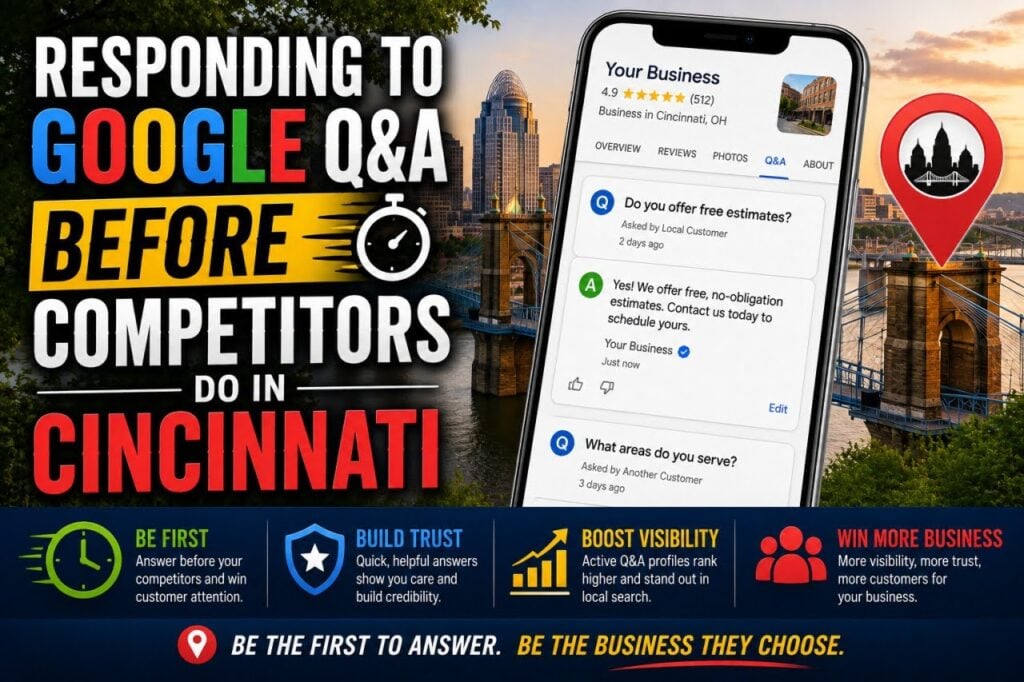
When Cincinnati customers search for a local business, they often want answers quickly. They may need to know whether a company serves their neighborhood, offers a particular service, provides estimates, handles emergencies, or has experience with a specific type of project.
Google Business Profile can help answer many of these questions before a searcher ever reaches a company’s website. One feature businesses should pay attention to is the questions-and-answers information that can appear with their profile. Effective Google Q&A management helps businesses monitor customer questions, provide accurate information, and reduce the chance that prospective customers make decisions based on incomplete or incorrect answers.
For Cincinnati service businesses competing in local search, being responsive can help turn profile visitors into qualified prospects.
Why Google Q&A Matters for Cincinnati Businesses
Local searches often happen when someone is close to making a decision.
A homeowner might search for a plumber because of an immediate problem. A business owner may be comparing Cincinnati commercial contractors. Someone planning dinner might be deciding between several nearby restaurants.
At this stage, a simple unanswered question can create unnecessary friction.
Customers may want to know:
- Do you serve my area?
- Do I need an appointment?
- Do you offer this particular service?
- Can you handle large commercial projects?
- Are weekend appointments available?
- Is parking available?
- Is your location accessible?
Providing accurate answers can make it easier for customers to take the next step.
What Is Google Q&A?
Questions and answers associated with a Google Business Profile can provide searchers with useful information about a business.
Depending on Google’s current interface and features, people may encounter questions and answers while researching businesses through Google Search or Maps.
Unlike a private customer-service conversation, this information may be visible to other searchers.
That means one useful answer can potentially help more than the person who originally asked the question.
Why Businesses Should Monitor Questions
A customer asking a question is demonstrating interest.
If someone takes the time to ask whether your Cincinnati company offers a service, they’re potentially much closer to becoming a lead than someone casually browsing search results.
Ignoring those questions can mean missing opportunities to provide information at an important point in the buying process.
Regular Google Q&A management helps businesses identify and address these questions rather than allowing them to remain unanswered unnecessarily.
Answer Before Incorrect Information Spreads
Publicly visible information isn’t always accurate.
Other users may attempt to answer questions based on their own experiences or assumptions. Even well-intentioned responses can become outdated or fail to reflect the company’s current policies.
Businesses should therefore monitor information associated with their profiles and provide accurate clarification when appropriate.
The objective isn’t to compete aggressively with customers. It’s to make sure prospective customers can find reliable information.
Speed Can Influence the Customer Experience
Imagine someone comparing three Cincinnati contractors.
They want to know whether each company handles a specific type of project.
One business provides a useful answer quickly. Another has outdated information. The third provides no obvious answer at all.
Which company feels easiest to contact?
Responsiveness can influence perceptions of professionalism before a customer ever calls.
Create Clear and Useful Answers
A strong response should answer the actual question without unnecessary promotional language.
If someone asks:
“Do you provide commercial remodeling in downtown Cincinnati?”
A useful response might explain whether the company offers that service and encourage the customer to contact the business to discuss project requirements.
Avoid turning every answer into a long sales pitch.
Helpful answers build confidence more effectively than keyword-stuffed responses.
Keep Answers Accurate
Never provide an answer simply because it sounds good from a marketing perspective.
If service availability depends on:
- Location
- Project size
- Scheduling
- Product availability
- Property type
- Season
- Other requirements
say so.
Accurate expectations help prevent wasted calls and disappointed customers.
Answer Location Questions Carefully
Cincinnati service businesses frequently receive geographic questions.
Customers may ask whether a company serves:
- Downtown Cincinnati
- Hyde Park
- Oakley
- West Chester
- Mason
- Blue Ash
- Anderson Township
- Northern Kentucky
Don’t claim to serve locations that fall outside the company’s actual service area.
When coverage varies, encourage customers to contact the business with their location for confirmation.
Address Service Questions Directly
Service-related questions can be highly valuable because they reveal exactly what prospective customers want.
Examples include:
- Do you install commercial roofing?
- Do you offer pool renovations?
- Do you repair hot tubs?
- Can you accommodate large groups?
- Do you provide private boat charters?
Clear answers help searchers determine whether the business is relevant before making contact.
Use Customer Questions to Improve Your Website
Repeated questions can reveal missing information elsewhere in your marketing.
If Cincinnati customers repeatedly ask whether you provide a particular service, your website may not explain that service clearly enough.
Common questions can inspire improvements to:
- Service pages
- FAQ sections
- Location pages
- Blog posts
- Contact pages
- Google Business Profile information
In this way, Google Q&A management can become a useful source of customer research.
Look for Questions About Pricing
Price is naturally one of the most common concerns for customers.
Businesses don’t always need to publish a fixed price, particularly when costs depend on individual circumstances.
Instead, explain what influences pricing.
For example, a contractor might explain that project pricing depends on:
- Scope
- Materials
- Site conditions
- Schedule
- Design requirements
Then direct the customer toward the appropriate estimate or consultation process.
Keep Hours and Availability Updated
Customers may ask questions because information elsewhere on the profile is unclear.
If people repeatedly ask whether you’re open on Saturdays, review whether your operating hours are current.
The same principle applies to:
- Holiday hours
- Appointment requirements
- Seasonal schedules
- Service availability
Good Google Q&A management should work alongside broader Google Business Profile maintenance.
Don’t Use Q&A for Keyword Stuffing
Because questions and answers can appear around local search results, some businesses may be tempted to fill responses with repetitive geographic and service keywords.
Avoid this approach.
An answer such as:
“Yes, we’re the best Cincinnati plumber for Cincinnati plumbing services throughout Cincinnati.”
isn’t useful to a customer.
Write naturally and provide the information someone actually needs.
Maintain a Consistent Brand Voice
Responses should sound like they came from the same business.
Whether your company communicates in a formal, friendly, technical, or conversational style, maintain reasonable consistency.
For Cincinnati service businesses, answers should generally be:
- Professional
- Clear
- Concise
- Accurate
- Helpful
Customers shouldn’t have to decode marketing language to find a simple answer.
Know When to Move the Conversation Offline
Some questions require details that shouldn’t be discussed publicly.
A customer may need to provide:
- Contact information
- Property details
- Account information
- Project specifications
- Personal information
In these situations, provide a general answer and direct the customer to an appropriate private communication channel.
Never encourage customers to publish sensitive information publicly.
Monitor for Outdated Answers
Business information changes.
A response that was correct two years ago may no longer reflect current:
- Hours
- Services
- Policies
- Locations
- Products
- Pricing
Periodic profile reviews can help identify information that may need clarification or updating where Google’s available tools permit.
Handle Negative or Challenging Questions Professionally
Not every public question will be positive.
Some users may ask about:
- Complaints
- Service problems
- Pricing disagreements
- Delays
- Policies
Don’t respond emotionally.
Provide factual information where appropriate and direct individual customer-service issues toward a private resolution channel.
Professional responses can matter because other prospective customers may see the interaction.
Don’t Argue With Other Contributors
If another user provides inaccurate information, focus on correcting the information rather than attacking the person.
A simple clarification is usually more effective.
The goal of Google Q&A management is to make useful information available to prospective customers, not to win a public argument.
Develop an Internal Response Process
Businesses with multiple employees should establish responsibility for monitoring local profiles.
A simple workflow might be:
- Review the profile regularly.
- Identify new or inaccurate information.
- Verify the correct answer internally.
- Respond clearly when appropriate.
- Escalate sensitive issues to management.
- Record recurring customer questions.
Having a process reduces the likelihood that important questions are overlooked.
Create an Approved Answer Library
Many customer questions repeat.
Businesses can prepare internal guidance for common topics such as:
- Service areas
- Appointment policies
- Estimates
- Parking
- Accessibility
- Reservations
- Product availability
- Emergency services
These shouldn’t become robotic copy-and-paste responses. Instead, they can give employees accurate information to work from.
Use Questions to Understand Search Intent
Customer questions reveal what matters to local prospects.
If Cincinnati homeowners frequently ask whether a contractor handles older properties, that’s valuable information.
If restaurant customers repeatedly ask about gluten-free options, that’s valuable too.
These questions can help businesses understand the concerns that influence purchasing decisions.
Coordinate Q&A With Your Google Business Profile
Q&A shouldn’t operate independently from the rest of the profile.
Make sure your business information remains consistent across areas such as:
- Categories
- Services
- Hours
- Contact information
- Website
- Business description
- Photos
If customers repeatedly ask about information that should already be clear elsewhere, investigate why they’re having difficulty finding it.
Connect Q&A Insights With Local SEO Content
Recurring customer questions can also become useful content topics.
Suppose customers repeatedly ask:
“Do you serve businesses outside downtown Cincinnati?”
That could indicate a need for clearer service-area information on the website.
Similarly, questions about specific services may reveal opportunities for detailed service pages or educational articles.
This creates a useful cycle:
Customer Question → Helpful Answer → Website Improvement → Better Customer Experience
Monitor Multiple Cincinnati Locations Separately
Businesses operating several locations shouldn’t assume customers ask the same questions everywhere.
One location may receive frequent questions about parking, while another receives questions about appointments or service availability.
Review each profile independently so answers remain relevant to that specific location.
Avoid Making Unverified Ranking Claims
Google Business Profile activity is important for customer experience, but businesses should be careful about claiming that answering Q&A directly produces a specific ranking increase.
Local visibility depends on many factors.
The strongest reason to manage questions is straightforward: customers need accurate information before deciding whether to contact or visit your business.
Any SEO strategy should prioritize that usefulness rather than treating Q&A as a ranking manipulation technique.
Track Whether Common Questions Decline
One interesting way to evaluate improvements is to observe whether certain questions become less common after you improve your website and profile.
If customers previously asked about your service area every week but stop asking after you make the information clearer, that can indicate your marketing is answering their questions earlier.
Not every success metric needs to be a ranking position.
Make Q&A Part of Reputation Management
Public business information contributes to the overall impression customers form about a company.
Reviews may show what previous customers experienced. Photos show what the business looks like. Business information explains what it offers. Questions and answers can address specific concerns.
Together, these elements shape trust.
Consistent Google Q&A management can therefore support a broader reputation-management strategy.
FAQs
What is Google Q&A management?
Google Q&A management involves monitoring questions and answers associated with a business’s Google presence, providing accurate information where appropriate, and addressing outdated or misleading information through available Google features.
How quickly should Cincinnati businesses respond to questions?
Businesses should monitor their profiles regularly and address relevant questions as promptly as practical. High-intent questions about services, availability, or locations may deserve particular attention.
Can other people answer questions about my business?
Public contribution features can allow information to come from sources beyond the business itself, depending on Google’s current product functionality. That’s one reason businesses should monitor their profiles.
Should I put keywords in Google Q&A answers?
Write naturally. If a service or location is genuinely relevant to the question, mentioning it can make sense, but repetitive keyword stuffing makes answers less useful.
Can Google Q&A improve Cincinnati map rankings?
Businesses shouldn’t assume Q&A responses alone will produce higher Maps rankings. Their clearest value is providing useful information to searchers and strengthening the overall quality of the business’s local presence.
Final Thoughts
Winning local customers often comes down to reducing uncertainty. Someone searching for a Cincinnati business may already be interested, but one unanswered question about services, availability, location, or policies could prevent them from taking the next step.
Effective Google Q&A management helps businesses stay aware of the questions prospective customers are asking and provide clear, accurate information when it matters.
Rather than viewing Q&A as another place to stuff keywords, Cincinnati businesses should treat it as part of the customer experience. Monitor your profile, answer useful questions promptly, correct misinformation professionally, and use recurring questions to improve the rest of your marketing.
When customers can quickly find the information they need, choosing your business becomes that much easier.