Why PPC Pros Emphasizes First-Click vs Last-Click Analysis
A customer rarely sees one advertisement, clicks it, and immediately makes a purchase. Modern buying journeys often involve multiple searches, advertisements, website visits, devices, and marketing channels before someone finally becomes a lead or customer.
That complexity makes attribution an important part of PPC analysis. PPC Pros Google Ads strategies can examine first-click and last-click interactions to better understand how different campaigns contribute to the customer journey rather than evaluating performance solely from the final interaction.
Understanding the difference can help businesses make smarter decisions about budgets, campaigns, keywords, and long-term advertising strategy.
What Is PPC Attribution?
Attribution is the process of determining how credit for a conversion is assigned across marketing interactions.
Imagine a potential customer who:
- Searches for a service and clicks an ad.
- Leaves without converting.
- Returns several days later through another marketing channel.
- Searches for the company again.
- Converts during a later visit.
Several interactions contributed to that customer journey. Attribution analysis helps marketers understand the roles those touchpoints played.
What Is First-Click Attribution?
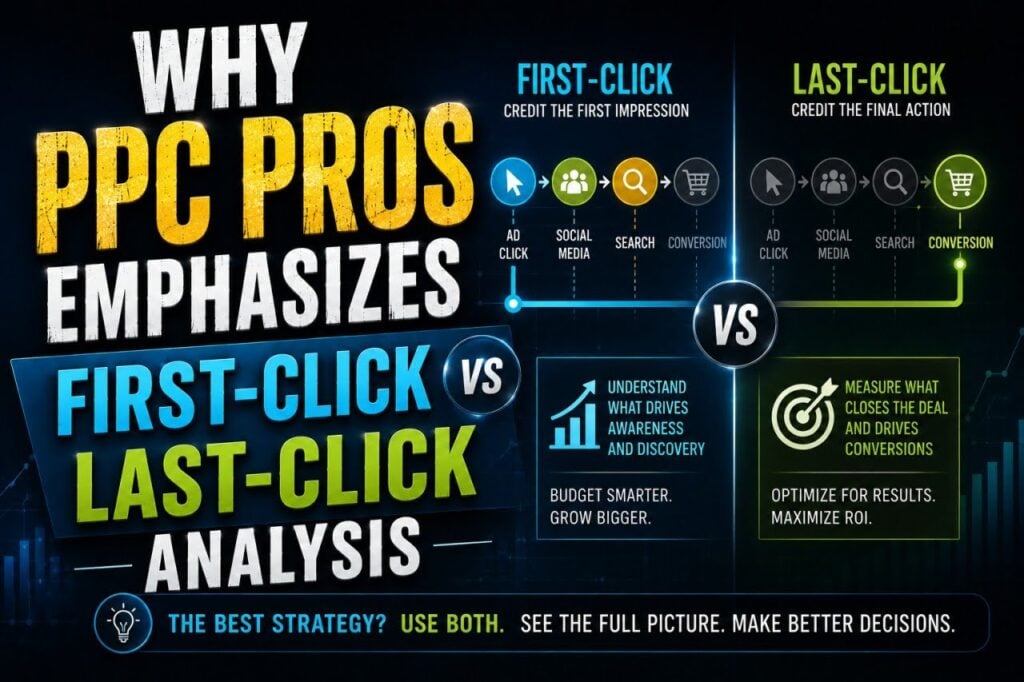
First-click attribution focuses on the initial tracked interaction that introduced a customer to the conversion journey.
In a simplified example, someone might:
- Click a non-brand PPC ad
- Visit the website
- Return through organic search
- Later click a branded ad
- Submit a form
A first-click perspective emphasizes the original PPC interaction because it helped introduce the customer to the business.
This can be useful when evaluating customer acquisition and discovery campaigns.
What Is Last-Click Attribution?
Last-click attribution gives conversion credit to the final eligible interaction before the conversion.
Using the previous example, the branded ad that occurred immediately before the form submission might receive the credit under a last-click approach.
Last-click reporting can help marketers understand which interactions occur closest to conversion, but it may not fully explain how the customer originally discovered the business.
Why the Difference Matters
Looking exclusively at one attribution perspective can create an incomplete picture.
A campaign that introduces many valuable prospects may appear less important under last-click analysis if customers frequently return through another channel before converting.
Similarly, a campaign that frequently closes conversions may look extremely strong even though another campaign originally generated much of the demand.
PPC Pros Google Ads analysis can consider these differences before making major budget decisions.
First Click Helps Reveal Discovery
First-click analysis can provide insight into how customers initially enter the marketing funnel.
This can be especially useful for:
- Non-brand search campaigns
- New service campaigns
- Competitive keyword campaigns
- Awareness-oriented advertising
- New geographic markets
These campaigns may introduce potential customers who aren’t ready to convert during their first visit.
Last Click Shows What Happens Near Conversion
Last-click analysis can help identify campaigns and interactions that frequently appear near the end of the buying journey.
These may include:
- Brand searches
- High-intent service searches
- Remarketing interactions
- Returning visitors
- Product-specific searches
Understanding these closing interactions is valuable, but marketers should avoid assuming they were solely responsible for generating the customer.
Attribution Can Prevent Premature Budget Cuts
Suppose a campaign produces relatively few conversions when viewed only through a narrow last-interaction lens.
It may be tempting to reduce its budget.
But what if that campaign frequently introduces customers who later convert through another interaction?
Reducing the campaign could potentially decrease the number of prospects entering the funnel.
This is why attribution context matters before reallocating significant advertising spend.
Understand Branded Search More Clearly
Brand campaigns can sometimes appear exceptionally efficient because people searching for a company’s name may already be familiar with the business.
A customer might initially discover the company through a non-brand advertisement and later search directly for the brand before converting.
If marketers only focus on the final interaction, they could overestimate the role of branded search while undervaluing the campaign that created the initial awareness.
Evaluate Non-Brand Campaigns More Fairly
Non-brand campaigns often reach people earlier in their decision-making process.
Examples might include searches such as:
- Emergency plumber near me
- Commercial contractor Cincinnati
- Hot tubs for sale
- Nassau boat excursions
These searchers may still be comparing options.
First-interaction and broader attribution analysis can help marketers understand whether these campaigns contribute to conversions later in the journey.
Improve Keyword Decisions
Attribution analysis can also provide additional context when evaluating keywords.
A keyword may not always generate immediate conversions but could still introduce valuable prospects.
Before pausing a keyword, PPC Pros Google Ads specialists can consider factors such as:
- Conversion paths
- Search intent
- Lead quality
- Cost
- Assisted interactions
- Overall campaign role
The objective is to understand business impact rather than judging every keyword from a single metric.
Understand Longer Sales Cycles
Attribution becomes particularly important for businesses with longer decision-making processes.
Examples can include:
- Commercial construction
- Professional services
- Luxury purchases
- High-ticket home improvements
- B2B services
Customers may conduct extensive research before contacting a company.
A person considering a major construction project, for example, could interact with a business several times over weeks before requesting a consultation.
Attribution Matters for High-Ticket Purchases
Expensive products and services typically require more consideration.
Someone shopping for a luxury watch, swimming pool, hot tub, or major professional service may:
- Search multiple times
- Compare competitors
- Read reviews
- Visit several pages
- Return through different channels
- Contact the business later
Giving all conversion credit to the final interaction can oversimplify that process.
Compare PPC With Other Marketing Channels
Paid search rarely operates completely independently.
A customer’s journey might involve:
- Google Ads
- Organic search
- Direct visits
- Social media
- Referral traffic
Attribution analysis can help marketers investigate how these channels work together rather than treating each one as an isolated system.
Use Attribution to Improve Budget Allocation
Budget allocation should reflect the role campaigns play in generating valuable business outcomes.
Marketers can examine which campaigns:
- Introduce new prospects
- Capture high-intent searches
- Support returning customers
- Generate qualified leads
- Contribute to completed sales
This broader understanding can lead to more informed budget decisions.
Don’t Ignore Lead Quality
A conversion isn’t automatically a valuable customer.
Two campaigns might each generate 20 leads, but one could produce significantly more revenue.
Whenever possible, attribution analysis should be combined with downstream information such as:
- Qualified leads
- Appointments
- Closed sales
- Revenue
- Customer value
This helps businesses optimize toward meaningful outcomes rather than simply maximizing form submissions.
Connect Advertising Data With CRM Results
For lead-generation businesses, integrating advertising data with customer relationship management systems can provide additional insight.
A CRM may reveal what happened after the initial conversion, including:
- Whether the lead was qualified
- Which service was requested
- Whether an appointment occurred
- Whether the deal closed
- How much revenue was generated
Connecting marketing interactions with actual business outcomes can improve PPC decision-making.
Consider Data-Driven Attribution
First-click and last-click analysis are useful conceptual perspectives, but they aren’t the only ways to evaluate conversions.
Modern advertising and analytics platforms may offer data-driven attribution approaches that distribute credit across eligible interactions based on available conversion-path data and platform methodology.
The exact attribution options available can change over time, so advertisers should review the current capabilities of their Google Ads and analytics setup.
Attribution Isn’t Perfect
No attribution model provides a flawless representation of human decision-making.
Tracking can be affected by:
- Multiple devices
- Cookie limitations
- Privacy settings
- Offline conversations
- Phone calls
- Tracking configuration
- Cross-channel behavior
Attribution data should therefore be treated as a decision-making tool rather than an absolute record of every influence behind a purchase.
Focus on the Entire Customer Journey
The ultimate goal isn’t to prove that first click or last click is universally better.
It’s to understand how different marketing interactions contribute to customer acquisition.
PPC Pros can use attribution analysis alongside campaign data, conversion tracking, CRM information, and revenue outcomes to develop a more complete picture of performance.
That perspective can lead to better decisions than simply asking, “Which ad received the final click?”
FAQs
What is first-click attribution?
First-click attribution assigns conversion credit to the first tracked marketing interaction in the customer’s journey under that attribution approach.
What is last-click attribution?
Last-click attribution focuses conversion credit on the final eligible interaction before a customer completes the desired action.
Is first-click attribution better than last-click attribution?
Not necessarily. Each perspective answers a different question. First click can highlight discovery, while last click emphasizes the interaction closest to conversion.
Why can last-click reporting undervalue some PPC campaigns?
Campaigns that introduce customers earlier in the buying journey may not receive final-interaction credit even though they contributed to generating the eventual conversion.
Why does PPC Pros Google Ads analyze different attribution perspectives?
PPC Pros Google Ads analysis can compare different points in the customer journey to better understand which campaigns introduce prospects, which interactions occur closer to conversion, and how advertising budgets can be allocated more effectively.
Final Thoughts
Customers don’t always follow simple, linear paths from advertisement to purchase. They search, compare, leave, return, read reviews, interact with different channels, and eventually make a decision.
That’s why PPC Pros Google Ads analysis shouldn’t rely on a single interaction to explain the entire customer journey. Comparing first-click and last-click perspectives, while also considering broader attribution data and actual business outcomes, can reveal how campaigns work together to attract and convert customers.
With a more complete understanding of attribution, businesses can make better-informed decisions about keywords, campaigns, budgets, and the marketing activities that contribute to sustainable growth.